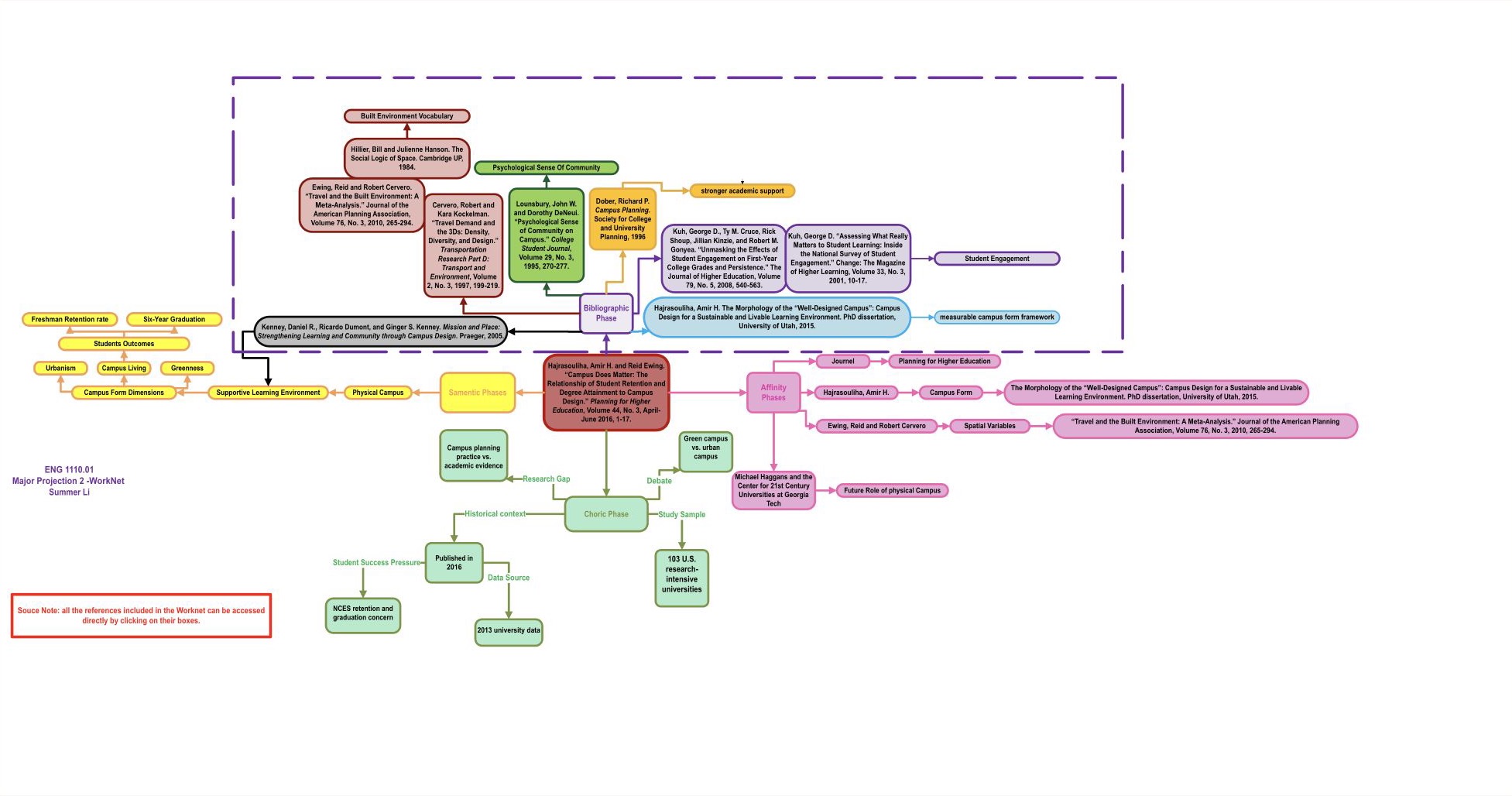
This section examines Amir Hajrasouliha and Reid Ewing’s 2016 article, “Campus Does Matter.” The authors ask whether campus form is associated with student retention and degree completion. The question, terms, findings, and limitations below introduce the article before the WorkNet presents its main ideas and research connections. These ideas also provide some context for thinking about why the five buildings in this guide still matter to students today.
THE QUESTION
Can physical campus form support student success?
Amir Hajrasouliha and Reid Ewing studied 103 U.S. universities with high or very high research activity. They compared freshman retention and six-year graduation with aspects of campus form while controlling for institutional factors. Their question fits Ohio State because a research university depends on a network of buildings, open spaces, routes, and campus services.
THE TERMS
Urbanism, greenness, and campus living
The authors first considered seven dimensions of campus form. Their final model focuses on urbanism, which includes compactness, connectivity, and context, as well as greenness and campus living. The categories direct attention to the distances and routes among Thompson, the Union, residence spaces, communication spaces, and recreation, as well as each building’s interior.
THE FINDING
Form is associated with retention and graduation
All three main campus-form variables were associated with freshman retention; greenness and campus living also had direct relationships with six-year graduation. This is not proof that a renovation causes an individual to graduate. It supports a narrower claim: environments structure daily opportunities to study, meet, rest, move, and build connections, and those experiences can contribute to persistence.
How the evidence works together
A framework for reading campus support
-
Campus form creates conditions.
Hajrasouliha and Ewing provide the broadest level of the framework. Urbanism, greenness, and campus living describe how routes, land uses, landscape, and residential patterns can shape repeated opportunities to study, meet, move, and remain connected to university life.
-
Students experience those conditions unevenly.
Belonging and place-attachment research adds the human level. A space may be available on a campus plan but still feel difficult to enter, interpret, afford, or claim. Student perception therefore helps explain why physical proximity is not the same as practical access.
-
Archives show how support was defined.
The five building records and student publications reveal what OSU funded, whom it consulted, and what each project was expected to accomplish. The 1932 Walker House evidence also shows that an institution can create support while enforcing exclusion.
-
Current services test whether the promise continues.
Official resource pages connect the historical mission to present use: research help at Thompson, student media and organizations in Journalism, engagement services at the Union, lower-cost cooperative housing through ASH, and wellness resources at RPAC.
-
Access is the final test.
The guide evaluates every case with the same question: can students find, enter, understand, afford, and use the support? This produces a practical conclusion rather than a building ranking. Design creates capacity; policies, information, cost, and culture determine who benefits.
Evidence chain
Campus form → daily opportunities → student experience and belonging → persistence
This is an interpretive framework, not a claim that a single building causes retention or graduation.
What the focal article establishes
The 103-university study offers campus-level statistical associations and controls for institutional characteristics. It supports comparing patterns across campuses, but its cross-sectional design cannot establish individual causation.
What the local artifacts contribute
Administrative records establish dates, names, functions, and expansion. Student and alumni publications add use, participation, conflict, and exclusion. Together they prevent square footage from standing in for student experience.
What remains outside the model
Teaching, advising, disability access, discrimination, work, family responsibility, health, and affordability also shape persistence. These limits are not side notes; they explain why the guide treats inclusive access as the bridge between design and support.